- What does the idea that people must “formulate or construct their own understanding” mean to you as a learner? As a musician-scholar-teacher? In what ways or when have you “constructed your own understanding”, either intentionally or unintentionally? What did that involve? How did you know that that you “knew” something?
To me, as a learner, the idea that people must “formulate or construct their own understanding” means that we all have had our own journey in life, so we all have different ways of viewing ideas. We all understand ideas differently because of what we know and do not know. As a musician-scholar-teacher, this means that I have to put myself in my students’ shoes and adapt to what the students need because they have their own ways of understanding. As a teacher, I have to think outside the box so that everyone is learning and understanding. When students start to make connections in a lesson, the students start to understand on their own and take ownership of what they are learning. One way that I can think of how I have “constructed my own understanding” has been when I play any clarinet repertoire or ensemble pieces. Those pieces may have a hard passage that I cannot play, and I would have to slow it down to play every note. Since I practice my scales, arpeggios, and thirds every day I start to identify those different patterns in my music which makes it easier for me to play. It just took me a little bit of time to notice that it was a pattern that I knew.
- Make a “schema map,” similar to the hamburger map, that illustrates what you know about children and music. Consider the understandings you have from the entirety of your experience, not just this class. Bring your map to class. Include it in your post about this assignment if at all possible. Based on your schematic drawing, what do you want to know next? What are you curious about?
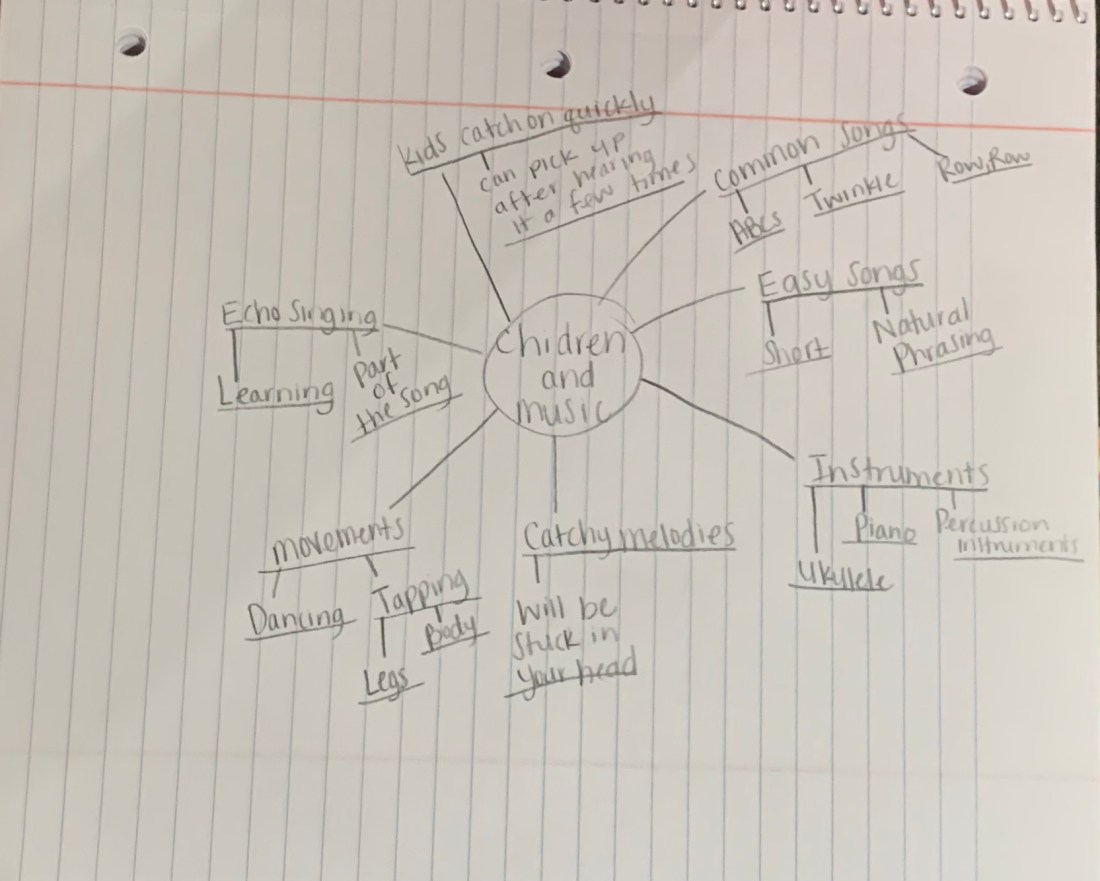
I want to know how long it takes for children to catch onto songs? I am also curious about how many children’s songs the kids know.
- Wiggins asserts that because are schemas are different, people’s interpretations of the same experiences and information can be very different. What does that idea mean for you as a teacher?
The idea that everyone’s schemas are different means for me as a teacher that not everyone is going to learn the same and not everyone is going to know the same information. Some students are going to know more than others. So, I will have to keep in mind that a certain way I say something may be interpreted completely different from student to student. I will have to make sure that I am constantly assessing my students to see if they are understanding the lesson. An example for this idea is how a certain food like pizza can bring different meaning to different people. I like pepperoni on my pizza, however, someone else may like ham and pineapple on it. Pizza brings me memories of birthday parties because I used to have pizza as a meal. Someone else may have other memories associated to pizza.
- We’ve already been talking about whole-part-whole. What does Wiggins have to say about the relationship of parts and wholes?
What Wiggins has to say about parts and wholes relationship is that it is easier for people to understand a part of something when it is learned in the context of a whole. We usually understand things if they in relations to other things. Wiggins also says that as teachers we need to make sure we present all material within the context that we are teaching. A place that I have seen the idea of whole-part-whole is in art of teaching beginning instrumentalist. We taught a lesson where we (the students) played a phrase we were working on and the teacher broke it down into small sections to work on. At the end we played through the entire phrase to see what we had fixed. We had context of the whole (the phrase we played), the part was when the teacher worked on different places in the phrase, and the whole was also when we played through the entire phrase one last time to assess how much the teacher fixed.
- Scaffolding . . . what is that? Have you used it? Have you seen it used? Describe!
Scaffolding is when the teacher models how to solve a certain problem and then steps back to see how the student can work on the problem on their own. The teacher is there to assist the students when they need help. I have used scaffolding many times. I have used it at my previous internships. I have asked a section of instruments to play their part and have the rest of the students listen to those students. After they are done playing through their part, I ask the students what they heard, if they do not have anything to say, I help them by giving them guided questions to help them think about things they heard. I have also seen it used in my internships by my mentor teachers. They used it by playing the example first on the keyboard then having the students play the example as a class and then teacher chimed when the students were falling apart. The teacher asked the students questions about how they did and helped the students figure out what they can do to make it better.
- If learning is social, and if the Zone of Proximal Development is really a “thing” then why do we send kids to practice alone? In what ways have you experienced learning as social construction? How might you use the idea of the Zone of Proximal Development to good advantage in your pedagogical practice?
We send kids to practice alone because they are still capable of doing it on their own. When they come into our classroom, they learn ideas that they can apply on their own. In the classroom, they are still learning socially because they around others, but they can use what they learned while practicing alone. A way I have experienced learning as social construction is when I practice with my friends. This allows my friends to give me feedback on my playing especially when I am not pay attention to a certain part of my playing. I also do this with my friends and give them feedback when they are not getting something. Sometimes my friends know something else that I don’t, and they help me with it. An example is that this week I was working on glissandos, I was having a hard time getting them and they gave me different ways that they do it. I could use the idea of Zone of Proximal Development in my pedagogical practice by giving my students a few minutes to converse and help each other after learning something new. Sometimes they get the concept better when a peer is helping them out.
- Consider that you are, we are, in a “cognitive apprenticeship” about music learning and teaching. How are you learning in this course or other experiences? What do you need more of? Less of?
The way I would be learning in a cognitive apprenticeship would be by me working closely with my mentor. They would guide me through processes that I do not know about and they would not throw me in right away into something I do not know how to do. They would build off a concept or idea that I already know about and let me teach in areas I know right away. My mentor would have to guide me in the areas I am not the best in. I would need more experience teaching in a cognitive apprenticeship because as students we learn the best while experiencing an activity. By teaching, I would get more comfortable in areas that I am good at and would get feedback in the areas I am not the best at. This type of experience reminds me of an internship except instead of always observing our mentors, we are working side-by- side with them.

 Lizeth's Blog