Video 1: Masai children singing
Listen for a little bit. What do you notice about the structure of the song the children are singing? Who is the leader? About the pitch level? About the quality of their voices? How would you characterize the feeling or affect of the children who are singing?
The song started off with the whole group singing a part of the song and then it went to a call and response with one leader singing the phrases and the entire group responding. The leader is one of the boys in the front that is singing with the group. The pitch level is very high and it cuts through the group when they all sing together. I would characterize the feeling of the children who are singing as playful. They are all having fun while singing and jumping around with lots of energy.
Video 2: PS22 Chorus “EMPIRE STATE OF MIND Pt. XXII” Jay-Z & Alicia Keys
PS22 is in New York. Why this song for these children? What do notice about the children and how they are participating? How are they being led or facilitated? What do you notice about the quality of their singing? When is it best in tune (e.g., in what range)? What happens at the end?
I think they sang this song because they are from New York and they can relate to the lyrics of the song. The children get into the song when they get into the chorus. They all start dancing and moving around. Even when they are singing some of the verses, the children touch their chests and sway side-to-side. They are being led by their teacher on the piano. He counts them at the beginning and throughout the song he is tapping his foot. He also cues them by pausing before their big entrances. Their singing is well balanced throughout the song and it seems like a great quality of sound. I think their singing is best in tune when they are singing in a higher range. It seems like the kids are struggling to get some of the notes out when they sing in the low range. At the end of the video, the students celebrate when they are done and they show a bloopers of the kids having fun when they mess up.
Video 3: Children singing at Carden Academy Huntington Beach Music. Carden Academy Performing Arts
These are kindergarten and first-grade children. As you listen to the multiple verses of this song, what part do the children sing best? Who ends up singing the most? What does this tell you about choosing songs for children? In what key or what pitch level has the teacher put this song? What happens at the end?
The part that the children sing best are the parts that repeat over and over again, “they are all getting ready for Halloween night.” The teacher is the one that ends up singing the most because she is the one teaching the song and leading the children. It also seems like the children have a hard time saying sone of the words because they are younger and the words are longer. This tells me that usually songs with repeated sections are best for choosing songs for children because they get lots of practice with those parts. This song seems like a minor key because it is a Halloween song and a minor key usually makes it feel spooky. It also seems like this key is too low for the children. All the children end together at the end, but one of the kids tells a story to the teacher right after they are done.
Video 4: Cantare Con Vivo: Instructor Lydia Mills teaches South American Folk Song
This video is short and of the teacher only, though you see some children on the sides. The teacher is probably a guest artist visiting the class. She models a song for the children. Why are the children likely to enjoy this song? Why are they likely to sing it well? If you were teaching this song or wanted the children to sing with you, what strategy would you use next?
The children are likely to enjoy this song because there are instruments that are unique to a general music classroom and they do not hear those instruments too often. I think they are likely to enjoy it because the words of the song tell a funny story. I think they would be able to sing it well because a lot of the words repeat themselves and the melody also stays the same when the words change. The next strategy I would use next would be to ask the students a question about the song that it engages the students to listen to the song multiple times. I would sing it to them multiple times and ask them questions so that they hear it a lot before singing it. This will get the song in their head and learn it even without singing it. I would then do an echo sing on each phrase so that they get practice with shorter parts of the song. I would then have the students sing it in longer parts and then the entire song.
Video 5: Phoenix Children’s Chorus National Anthem at Diamondbacks Game – August 29, 2015
What do you notice about the age range of the children in this group? Their singing? Their song? Did you know about this group?
What I noticed about the age range of the children in this group was that it varied a lot. There were children of all ages. It seemed like it ranged from elementary school to high school. The children were singing in unison for most of the song. They broke out into harmonies in a few places and at the end. This group was singing the national anthem at a baseball game. I had heard about this group a few times when I was at community college, but I did not know much about them. I heard people mention this group, however, I still do not know much about this group.
Video 6: Ah Poor Bird!
“Ah Poor Bird” is a song in a minor key. OK, so . . . well . . . there are all kinds of problems, but not with the song itself. So what’s happening? Why is really going on? What’s your analysis of this situation?
The first time they sang the song, they were reviewing the song because they had done it before. The second time the children were told to sing with no movement and keep their hand on their lap/at their side which was different from the first time because they were moving all over the place. The third and fourth time they sang it, she asked the girls to sing by themselves and the boys to sing by themselves. Usually when teachers do this, they sing with their students, however, the teacher in this video leaves each group to sing on their own. The teacher then goes on and shows the kids a sign so that they could be quiet at the same time. The sign somewhat works because the kids think the sign was silly and the kids were not taking it seriously. She has the boys and girls do a round. It is not working very well because the kids were not super confident with the song by themselves and now they are doing it at different times. The teacher is also conducting them and the students really do not need that type of guidance. They may need the teacher to say certain words or even just clap the tempo because they are young and need simple to the point guidance. When she tries to fix something that the students are doing, she imitates what they did and the students do not take her seriously, they just start laughing at what she did. The teacher has lost the student’s attention by the end of the video and they just think it is funny and a game. At the end, the students were able to sing it in a round but it took them a while to do.
LAST: After all of this, what have you learned about children’s singing? What is singing about for them? What strategies will support children’s singing? What is not as good for them? List three principles or primary ideas that will guide your practice and provide a sentence or two for each describing why those ideas are important.
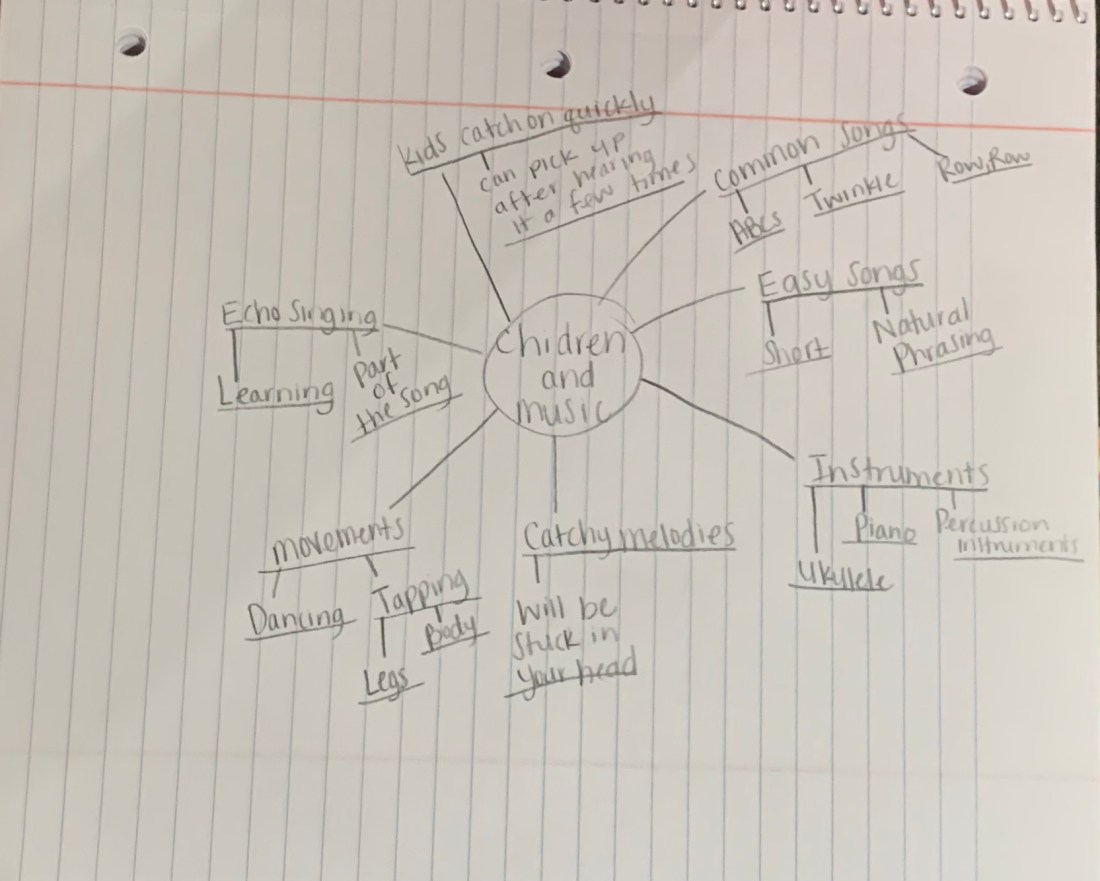
Overall, I learned that it is important to pick songs that are in the student’s range. Sometimes they are not able to be successful because the key is not right for them. It is also important to pick songs that are appropriate for the age group because depending what grade they are in, they might not be able to sing a complex song with lots of words. For the students, singing is about having fun for them. They do not care if they are sing the exact rhythm or the correct pitches, they just want to have fun singing. Some strategies that will support children’s singing is having songs that have easy melodies and repeated words so that they are able to be successful right away. Also, doing it over and over again, but making sure that they are doing something different with it each time so that they do not get bored. Something that is not good for them is conducting or doing complex things with the song. They need it to be simple so that they can catch on right away.
- Singing it a lot of times and doing multiple things with it. This will ensure that the students are practicing it a lot and not getting bored.
- Echo singing. This will help the students practice it in chunks so that when singing it as a whole they have practiced it in small chunks.
- Simplicity. Keeping my teaching simple will help the students a lot. They do not need me to be waving my hands around or they do not need to sing super complex songs. They will have fun if the song is super easy and simple.
 Lizeth's Blog